

Community is the Mission
By Pastor Lynn
Jesus models healthy rhythms of being alone with God and being with other people.
We’ve been experiencing and hearing about the importance of community this morning. Listening to each other, learning about one another, hearing how God is working among us, it draws us closer to each other and strengthens our community. We’ve listened to stories from Mark 1 and 2, about Jesus creating community and moving among different communities as he brought the message that the Kingdom of God is coming near.
What is a biblical definition of community? The Greek word for community is koinonia and it means a group of people who have a close association with each other involving mutual interests and sharing. This could be that you share a common ancestry, or common interests or passions, a common experience, like going to the same school or working in the same field or business. Any of these things can create a sense of community and you build a relationship around that.
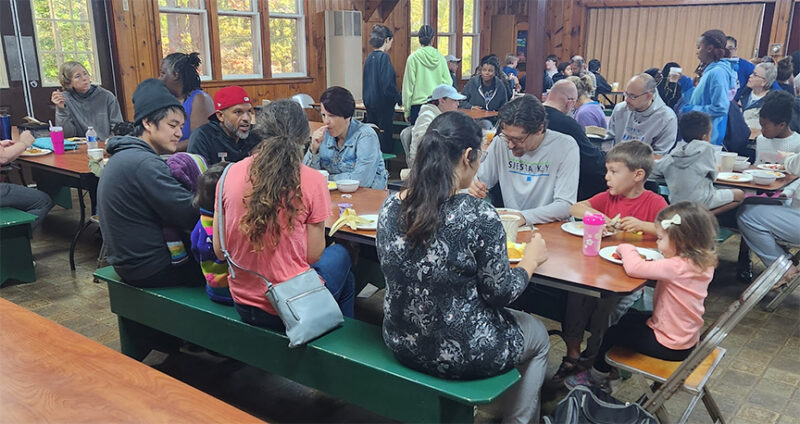
Koinonia also means you have a shared responsibility to one another in your community. You are aware of this and you act on it. So what I do affects you and what you do affects me. Paul talks about this in reference to the church as a body. In 1 Corinthians 12:25-26 he writes, “…there should be no division in the body, but that its parts should have equal concern for each other. If one part suffers, every part suffers with it; if one part is honored, every part rejoices with it.” This is one reason we do celebrations every month, and also why we pray for one another and have a prayer team. Community means we are interconnected, we share with each other in various ways, and we have an active interest in each other’s well being. If we hear someone is sick, we reach out and try to help. If we hear something good has happened in someone’s life, we reach out in congratulations, sharing their joy.
So now that we have an idea of what the Bible means by community, let’s look at Jesus’ movements in Mark chapters 1 and 2 in creating community.
First, we see Jesus walking along the Sea of Galilee where he sees Peter and Andrew and then James and John and he calls the 4 of them to follow him. And they all leave their nets and follow Jesus. These 4 men already knew each other. They were all fishermen, they may have all been relatives. Some scholars think Jesus and these men were all cousins. Andrew and most likely John had been followers of John the Baptist, who was Jesus’ cousin and had pointed them towards Jesus. So they already had a share in one another when they began following Jesus.
It’s usually fairly easy to form community with people when there is already something you have in common. I remember meeting my friend Annette in college. We were in the same dorm and we sat at the same table at dinner one night with some other freshmen from our dorm, and she commented that we both had the same watch. That’s what got us talking with each other. When you have a good conversation with someone, you want to talk with them again and we and our roommates began spending more time together and we all became very good friends and still are.
Jesus forms community with these 4 men who all have a lot in common and are ready to be together with Jesus in this little intimate community. They follow him to the synagogue, where Jesus teaches and casts a demon out of someone. This is a larger gathering, a social space, where people meet Jesus and are impressed with his teaching and his spiritual authority. They want to know more about him. Then Jesus and his 4 disciples go to Peter’s house. That’s a more private, intimate space, a smaller gathering where they can have more of Jesus’ attention. Jesus ends up healing Peter’s mother-in-law and she gets up and serves them. These common experiences draw these men closer together as a community around Jesus.
Then, all those people from the synagogue show up in the evening, after the Sabbath ends, with a bunch of sick friends and family so Jesus can heal them. Here’s a whole community of people, outside that intimate group of 4, who seek out Jesus. More and more people are coming together and the common denominator is Jesus. They all want to be with Jesus. And Jesus heals all the sick and casts out demons, restoring people to physical and spiritual wholeness. At this point, instead of trying to capitalize on his popularity, Jesus went away by himself to pray.
Creating community is great but we can’t just be with other people all the time. We need healthy rhythms of being alone with God and being with other people. Jesus models this for us. He left the crowds, left his small community of 4 followers, and went away to spend time with the Father. Community starts in the heart of God. In creating a community that centers around Jesus, we need that time alone with Jesus, talking with him, listening to him, letting Him transform the ways we think and act, and then going out and following him, doing the things that He does. In order to be koinonia, community, we need to be with God so that we ourselves are equipped and empowered to be in community with others.
Jesus didn’t call everyone who came to him to follow him like he called the 12. Many people listened to Jesus teach and were healed by him and many people followed him around. But he only called 12 to be with him in intimate community, and these 12, minus Judas, led and expanded the community of faith after Jesus ascended into heaven. And even from the 12 he chose 3 to be with him in special instances. So Jesus participated in several different “communities” that overlapped. For us, biblical community isn’t just OCMC. It may include neighbors, people we work with, friends at other churches, people at churches we used to go to.
For some people who came to Jesus, he told them to go back home, to their own communities, and share what God had done for them. Who, in our overlapping communities, do we need to share with about what God is doing in our lives? In Mark 1, when he heals the man with leprosy, Jesus tells him to go to the priest and offer the sacrifice the law required so he could be restored to the worshiping community. People with leprosy were cast out of community. They had to leave their families and villages and couldn’t worship in the synagogue or Temple. So in some cases, Jesus was restoring people to their own communities so they could tell about their experiences with Jesus and those communities could be transformed. Another great example of this is the Samaritan woman at the well who told everyone in her town about Jesus and many people came to believe in him and her relationships in that community were transformed.
For me, I had the experience of being an influence for transformation for my grandmother. She had been a follower of Jesus when she was younger but had done something that made her think that she had broken her relationship with Jesus and it couldn’t be fixed. She attended church but she didn’t feel close to Jesus and didn’t think the Lord would ever reach for her again. But she saw the transformation in me when I became a believer, she heard me talking about what God was doing in my life, and it gave her hope. Then one Sunday during worship, when the invitation was given to come forward for prayer, she came forward and was reconciled with Jesus. She said she heard His voice calling her and she wasn’t going to say no to Him again.
So community is the mission and we see Jesus creating communities in different ways. He calls people to be with him, he welcomes people to travel with him and learn, and he also heals people and sends them back to their own existing communities as a witness to transform those communities into spaces centered around Jesus. And then we get to chapter 2, where Jesus breaks a social barrier and calls a tax collector to follow him and become part of his intimate community.
Remember koinonia is a community where people have a share in one another. There is a sense of responsibility to each other and commonality like a family. If you’ve watched The Chosen series and seen when Jesus calls Matthew the tax collector to follow him, you’ve gotten a sense of how offensive this was to the other disciples. Matthew, or Levi, the tax collector was the enemy. He wasn’t family. He took their money and gave it to the Romans, who were occupying their land and didn’t mind being mean to people. My understanding is that tax collectors weren’t regulated and so they could charge whatever Rome demanded and then charge more so they could make a profit. Jesus was mixing fire and dynamite inviting Matthew to join the community with Peter, Andrew, James and John. But then we see that not only does Matthew follow Jesus, he brings along his own community of tax collectors and sinners and they sit down to dinner with Jesus and his community of fishermen. Transformation is happening. Something new is being created around Jesus.
This is why we must prioritize our relationship with Jesus first. I don’t have the ability to reconcile tax collectors and the fishermen who have to pay him. But Jesus can. We aren’t alone in trying to create community like Jesus did. Jesus has given us the Holy Spirit who empowers us to do the things Jesus did including our own transformation, reconciliation with God and others and the creation of koinonia.
The fishermen eat with the tax collectors and sinners. That means the fishermen are embracing a new set of values that actually goes against their culture. We see this when the Pharisees question why this is happening. Why are they eating with sinners? When we join with Jesus’ new community and we operate in a new way that is centered around Jesus and his values, his ways of doing things, we will probably experience push back from some of our old communities. That’s actually normal. Because our old community, culture, family system, whatever may not be centered around Jesus. The Pharisees were centered around the Law and their customs, which actually became about being centered around preserving their status. Jesus came to fulfill the Law, he said. He was actually bringing people back to the spirit of the Law, the heart of the Law, rather than the letter of the Law and that meant new ways of being and doing that grated against the old. But when we read on through the New Testament, we see that there are some among the Pharisees and the priesthood who become followers of Jesus. Jesus doesn’t shut the door on the communities we come out of. He keeps inviting them to join him around the table and embrace His new life.
Throughout these first 2 chapters of Mark, Jesus has been healing and casting out demons, bringing wholeness and health to people, and now we see how he’s transforming and healing broken relationships among people groups, to create koinonia, a fellowship that centers around the person of Jesus, with love and concern for each other. I see something similar happening in the organization that Sam started called Prayers for Peace Alliance. Christians, Muslims and Jews are coming together, not centered around Jesus himself, but because of their respective faiths, and they are seeking for an end to the war in Gaza and a peaceful existence for all in the Holy Land. They are a koinonia. They have a share in one another, a responsibility to one another and concern for one another.
We’ve heard this morning from our panel about how community has been important in their spiritual growth. We want to be a community that is centered around Jesus, where we can all experience transformation and growth, be supported and support others, care for and be cared for, and continuously welcome others who want to be in community with Jesus. We’re going to be talking about this over the next few months. Last week Pastor JoEl talked about how to be the people of God in troubled times like right now. Community is an important piece of that. We need the prayers, encouragement, support, and stories of one another. We need to be able to call on one another and be together, sometimes just to have fun, and sometimes to really minister to one another. We need to be asking God who, in the many different communities we move in, needs to hear what Jesus is doing in our lives so that we can introduce them to Jesus and His community.
What I want you to take away from this message is the idea that Jesus is forming new communities all the time, groups of people who center around Him, who are transformed by Him, empowered by His Spirit and on mission together to tell others about Jesus.
How can you be part of this?